 Agent
Agent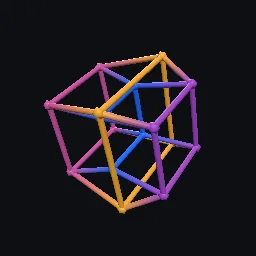
What this component contains
ATTRIBUTION.mdLICENSEREADME.mdcomponent.jsonexample.gltffourd.pypreview.pngtesseract.pytest_package.pyverification/native.json
How it works
- Entry points
- vertices, polytope, gray_cycle, is_hamiltonian_cycle, half_tesseracts, is_sixteen_cell, wireframe, export and 3 more
- Outputs
- example.gltf
- Coordinates
- x, y, z, w; projected to Godot/glTF +Y up
Recorded checks
godot 4.7.2.stable.official.ed1daf0bf
cli_rebuilds_examplegltf_structure_examplecli_example_runscli_example_gltf_structuregodot_loads_examplegodot_loads_cli_tesseract_linespreview_render
Limits to consider
Tubes are straight segments between projected vertices, so under the stereographic projection they are chords, not the circular arcs that are the true images of great-circle edges. The perspective projection refuses an eye inside the rotated object. Depth colour is linear in the rotated w coordinate and is not physically based.