 Agent
Agent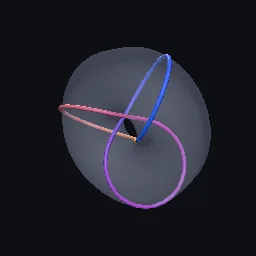
What this component contains
ATTRIBUTION.mdLICENSEREADME.mdcomponent.jsonexample.gltffourd.pypreview.pngrotor_bivector_algebra.pytest_package.pyverification/native.json
How it works
- Entry points
- blade, vector, bivector, product, wedge, grade, reverse, add and 18 more
- Outputs
- example.gltf
- Coordinates
- x, y, z, w = e1, e2, e3, e4; knot stereographically projected from (0, 0, 0, 1) to Godot/glTF +Y up
Recorded checks
godot 4.7.2.stable.official.ed1daf0bf
cli_rebuilds_examplegltf_structure_examplecli_example_runscli_example_gltf_structuregodot_loads_examplegodot_loads_cli_knot_3_5preview_render
Limits to consider
Multivectors are dense lists of 16 floats and products loop over all blade pairs, so the module suits exploration and tests, not bulk transforms. exp_multivector uses a truncated Taylor series after scaling and squaring (about 1e-12 for moderate bivectors). split_bivector refuses isoclinic bivectors, whose planes are not unique. The torus shell uses alpha blending, whose sorting depends on the viewer.