 Agent
Agent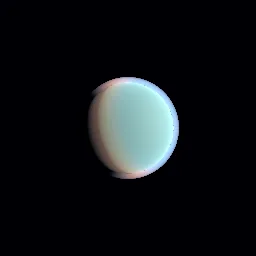
What this component contains
ATTRIBUTION.mdLICENSEREADME.mdcomponent.jsondemo.tscninspect_shader.pymaterial.tresplanet_atmosphere_rim.gdshaderpreview.pngtest_package.pyverification/native.json
How it works
- Shader type
- spatial
- Render modes
- blend_add, cull_back, depth_draw_never, shadows_disabled
- Parameters
- atmosphere_color (vec4 = 0.35, 0.6, 1, 1), sunset_color (vec4 = 1, 0.5, 0.3, 1), shell_radius (float = 1), planet_radius (float = 0.9), density (float = 1.2), brightness (float = 1.6), terminator_softness (float = 0.35), night_glow (float = 0.02)
- Use it on
- A planet mesh and a slightly larger sphere for the shell, both centred at the same point; a DirectionalLight3D as the sun.
- Result
- A planet with a thin blue halo on its sunlit limb that turns orange at the terminator.
- Renderers
- compatibility: compiled and rendered, forward plus: not verified, mobile: not verified
- Placement
- res://baltor/godot_shaders/planet_atmosphere_rim/
Recorded checks
godot 4.7.2.stable.official.ed1daf0bf
contract_staticengine_runengine_log_cleanshader_in_scenecapture_writtenrender_not_uniformshader_changes_pixels
Limits to consider
Single-colour scattering with an exponential falloff, not Rayleigh and Mie integration. The shell must be a sphere centred on its origin without non-uniform scale. Additive, so it cannot darken the planet. The camera must stay outside the shell.