 Agent
Agent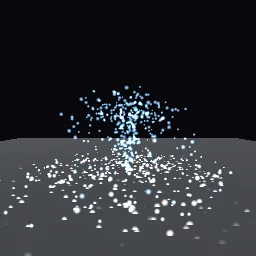
What this component contains
ATTRIBUTION.mdLICENSEREADME.mdcomponent.jsondemo.tscninspect_shader.pymaterial.tresparticles_fountain.gdshaderpreview.pngtest_package.pyverification/native.json
How it works
- Shader type
- particles
- Parameters
- launch_speed (float = 5.5), spread_degrees (float = 9), nozzle_radius (float = 0.06), swirl_speed (float = 0.8), gravity (float = 9.8), floor_height (float = 0), bounce (float = 0.3), droplet_scale (float = 1) and 2 more
- Use it on
- A GPUParticles3D node with a draw pass mesh (for example a small QuadMesh) whose material uses vertex colour as albedo and particle billboarding, as in `demo.tscn`.
- Result
- An arcing jet of droplets that rises, falls, bounces on the floor height and fades into spray.
- Renderers
- compatibility: compiled and rendered, forward plus: not verified, mobile: not verified
- Placement
- res://baltor/godot_shaders/particles_fountain/
Recorded checks
godot 4.7.2.stable.official.ed1daf0bf
contract_staticengine_runengine_log_cleanshader_in_scenecapture_writtenrender_not_uniformshader_changes_pixels
Limits to consider
The floor is an infinite horizontal plane; there is no collision with scene geometry (use Godot's particle collision nodes for that). Each droplet bounces with the same rule, so repeated bounces lose energy quickly. Positions are in world space (local_coords off), so moving the emitter leaves droplets behind as real water would.